




When sourcing custom pet products, many buyers ask the same question:
Why can't a manufacturer produce just 20 or 30 pieces?
For startups, small pet brands, online sellers, and businesses testing a new product, placing a small initial order seems like a sensible way to reduce inventory risk. Buyers may assume that if they are willing to pay a little more per piece, a supplier should be able to manufacture any quantity they request.
In reality, custom manufacturing does not work that way.
For products such as custom dog collars, leashes, and harnesses, production involves material preparation, machine setup, labor allocation, color matching, stitching, assembly, quality inspection, and packaging. Many of these activities require almost the same amount of preparation whether a factory produces 30 pieces or 300 pieces.
This is why a small customized order can cost significantly more per unit than a larger order. In some cases, even after charging an additional fee, a supplier may still lose money fulfilling a very small order.
Understanding the economics behind minimum order quantities (MOQs) helps buyers make better purchasing decisions and build more sustainable relationships with their manufacturing partners.
1. Custom Manufacturing Involves More Than the Cost of the Product
One of the most common misunderstandings in product sourcing is treating the unit price as if it only covers materials and assembly.
For a standard product manufactured in large quantities, production can follow an established process. Materials are already available, workers are familiar with the product, and machines may already be configured for the required specifications.
Customized production is different.
Depending on the project, a manufacturer may need to complete several steps before producing the first finished item:
Review the buyer's specifications and artwork.
Source or prepare the required materials.
Confirm colors, webbing widths, and thicknesses.
Select compatible buckles, D-rings, adjusters, and hooks.
Prepare sewing machines and production tools.
Adjust machine settings and stitching parameters.
Arrange production workers and assembly stations.
Produce samples or confirm a pre-production sample.
Inspect the finished products and prepare packaging.
Some of these costs are fixed or semi-fixed. They do not decrease significantly simply because the order quantity is smaller.
For example, preparing a production line for 30 custom dog harnesses may require many of the same preliminary steps as preparing it for 300 harnesses.
The difference is that the larger order provides more units over which to distribute those costs.
The central issue is not whether a supplier can physically produce 20 or 30 pieces. It is whether the production cost can be recovered at that quantity.
2. Production Setup Costs Remain Even When the Order Is Small
Machine adjustment is one of the most overlooked costs in custom manufacturing.
A factory may produce multiple pet product styles, sizes, colors, and configurations. When a new order arrives, the production team may need to change the existing setup.
Depending on the product, this can involve:
Changing thread colors.
Adjusting stitch length and sewing tension.
Replacing needles or adjusting sewing equipment.
Preparing different webbing widths.
Adjusting cutting dimensions and templates.
Reconfiguring assembly stations.
Checking the fit of buckles and other components.
Producing trial pieces before bulk production.
These tasks require time, skilled workers, and sometimes additional materials.
Consider a simplified example.
A factory has just completed an order of black dog leashes using 20 mm webbing. The next customer requests a different style using 25 mm webbing, a new thread color, a custom logo, and different hardware.
The factory cannot necessarily move directly from the previous order to the new one. Workers must prepare the new materials, adjust the process, and verify that the finished product meets the required specifications.
Whether the new order contains 30 pieces or 300 pieces, much of this setup work still needs to be completed.
This is why very small customized orders can carry disproportionately high setup costs.
Why machine adjustment matters
Machine adjustment is not simply about switching on equipment. The production team must ensure that the selected settings are appropriate for the materials and construction.
Incorrect stitching tension, unsuitable needle selection, or inconsistent feeding can affect appearance and product quality.
A responsible manufacturer must allow sufficient time for setup and verification rather than rushing directly into production.
For small orders, these necessary preparations can represent a substantial portion of the total manufacturing cost.
3. Labor Costs Do Not Decrease in Proportion to Order Quantity
Labor is another major reason why suppliers cannot always support extremely low MOQs at an economical price.
Custom pet products often involve multiple manual operations, including cutting, sewing, edge finishing, hardware installation, assembly, inspection, and packing.
Even when equipment is available, workers must still perform many of these tasks.
For a small order, the factory may need to assign workers to a production task that cannot keep them occupied for a full working period.
For example, producing 30 customized harnesses may require a worker to prepare materials, adjust the sewing process, complete the assembly, and inspect the finished pieces. The worker cannot necessarily complete these tasks at the same speed as an established high-volume production run.
In addition, small orders may interrupt the factory's existing production schedule.
Workers may need to switch between different product specifications, while production supervisors must coordinate the order and check that each detail matches the buyer's requirements.
The result is lower production efficiency.
The hidden cost of small production runs
A factory's labor cost is not determined only by the number of finished products. It also depends on how efficiently workers can perform the required operations.
If a production team spends a significant amount of time preparing an order but produces only 20 or 30 pieces, the labor cost allocated to each unit can become very high.
Charging a higher unit price may recover part of this expense, but it does not automatically make the order profitable.
This is particularly true when the product involves several sewing stages, multiple components, or individual customization requirements.

4. Material Purchasing Creates Another Challenge
Custom orders frequently require specific colors, dimensions, and material combinations.
For example, a buyer may request:
A unique Pantone color.
A particular webbing width or thickness.
A custom-colored buckle.
A special metal finish.
Matching materials for a collar, leash, and harness set.
Custom labels or printed packaging.
The supplier may not keep every possible combination in stock.
Some materials can only be purchased in minimum quantities from upstream suppliers. Others may need to be dyed, coated, printed, or manufactured specifically for the project.
Suppose a buyer needs 30 dog harnesses in a color that the manufacturer does not normally use.
The upstream material supplier may require a much larger purchase than the quantity needed for those 30 products.
The manufacturer then faces several possibilities:
Purchase more material than the order requires and absorb the remaining inventory.
Charge the buyer for some or all of the additional material.
Offer a standard color that is already available.
Decline the order if the economics are not workable.
Even if the buyer agrees to pay a higher unit price, the supplier may still be left with unused materials that cannot easily be applied to another customer's order.
This is especially challenging when the color, logo, or hardware specification is unique to one brand.
A low product quantity does not necessarily mean a low material purchasing requirement.
5. Why 20 or 30 Pieces May Still Result in a Loss
Let's look at a simplified example of a custom pet product order.
Assume a buyer requests 30 custom dog harnesses with a special color, logo, and selected hardware.
The following figures are hypothetical and are intended only to demonstrate the cost structure.
| Cost item | Illustrative cost |
|---|---|
| Production setup and adjustment | $60 |
| Sampling and specification confirmation | $40 |
| Additional material purchasing cost | $50 |
| Production labor and assembly | $90 |
| Quality inspection and order handling | $30 |
| Total cost before other overhead | $270 |
In this example, the manufacturer's cost is $270 before accounting for any additional factory overhead, administrative expenses, or profit.
Dividing $270 by 30 pieces gives a cost of $9 per piece.
If the supplier quotes $7 per piece, total revenue is only $210. The supplier loses $60 before considering other overhead and profit.
If the supplier quotes $9 per piece, the order merely covers the listed costs in this simplified example. There is still no allowance for additional overhead or profit.
If the supplier quotes $10 per piece, the order generates $300 in revenue, leaving $30 before other overhead and profit.
The actual figures will vary by product, factory, materials, and production requirements. This example is not a market quotation.
However, it illustrates an important point:
Even when a supplier charges a higher unit price for a small custom order, the additional revenue may not be enough to cover the full cost of production.
This is why some suppliers decline orders of 20 or 30 pieces even when the buyer is willing to accept a higher price.
They are not necessarily unwilling to serve small businesses. The requested quantity may simply be too small to support the required production process at a sustainable cost.

6. Why Custom Dog Harnesses Often Require Higher MOQs
Among common pet products, dog harnesses can be particularly challenging to manufacture in small customized quantities.
Unlike a simple leash, a harness typically consists of several connected components that must work together to provide a suitable fit and maintain consistent construction.
Depending on the design, a harness may include:
Multiple webbing straps.
Adjustable buckles and sliders.
D-rings or other attachment points.
Padded sections or mesh fabric.
Binding and edge finishing.
Reinforced stitching at important connection points.
Different sizes and color combinations.
Custom labels and branding.
Each component introduces additional purchasing, preparation, assembly, or inspection requirements.
A harness must also be assembled according to the correct dimensions and construction specifications. The position of straps, adjustment range, buckle compatibility, and stitching quality all influence the finished product.
Why size variations increase complexity
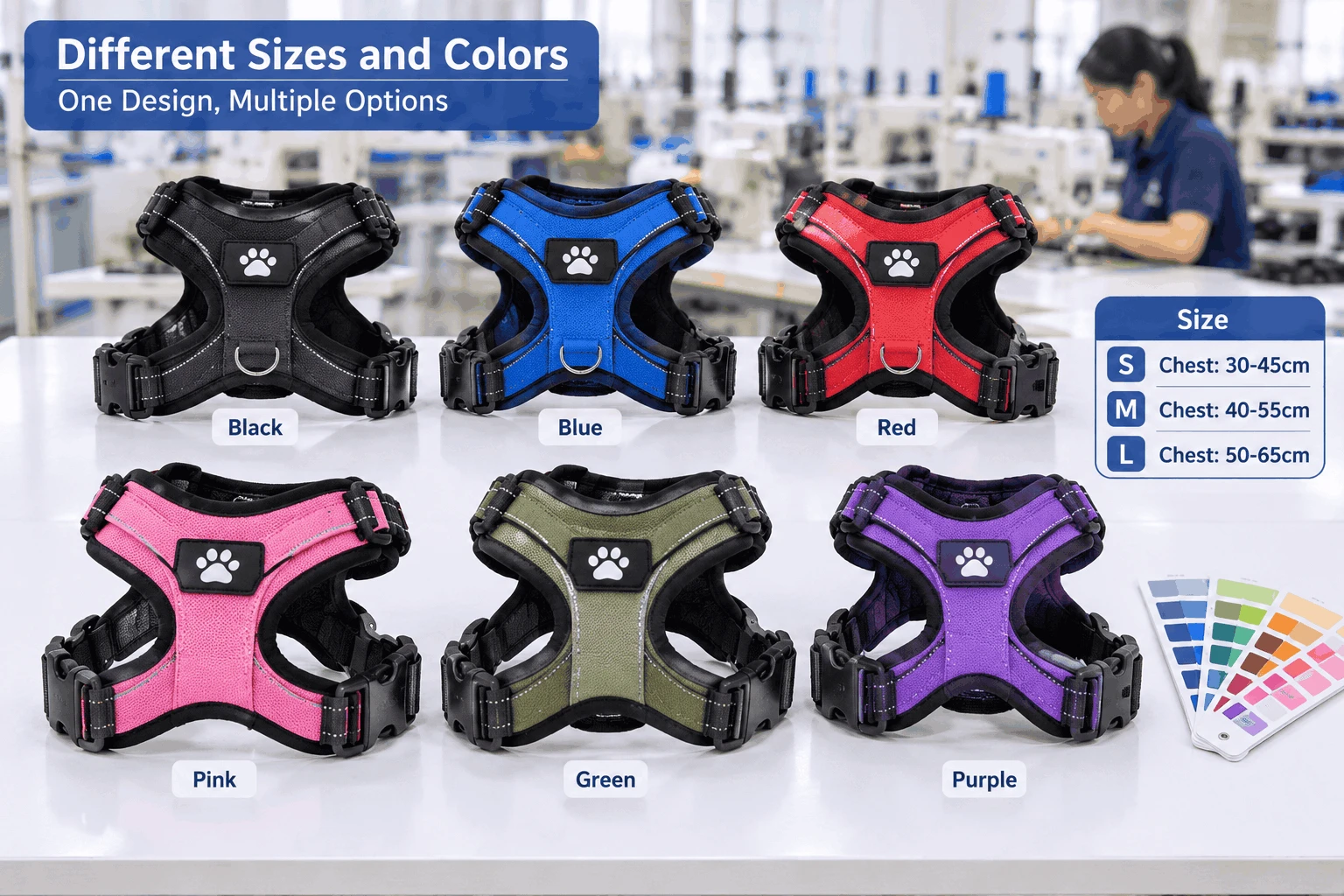
Consider a buyer who wants to launch one custom harness design in four sizes and three colors.
That creates 12 size-and-color combinations.
If the order contains only 100 pieces in total, the supplier must divide those units across the different combinations.
The factory may need to manage multiple material batches, cutting specifications, production adjustments, and packaging labels, while each individual combination has a relatively small quantity.
This makes purchasing and production planning less efficient.
For example, 100 harnesses in one color and one size are operationally different from 100 harnesses divided across four sizes and three colors.
The total quantity is identical, but the production complexity is not.
Why 500 sets can be a more practical starting point
For many custom harness projects, an order of approximately 500 sets or more can provide a more practical basis for production planning, depending on the design and the supplier's capabilities.
A larger order can help distribute setup costs across more units, improve material purchasing efficiency, and reduce repeated production adjustments.
However, 500 sets is not a universal MOQ for every harness. Existing designs, stocked materials, simple branding, and flexible production arrangements may allow smaller orders.
For a project involving substantial customization, multiple sizes, special colors, or custom components, a higher MOQ may be necessary to achieve a commercially workable price.
Buyers should therefore confirm whether the supplier's quoted MOQ applies to the entire order, each color, each size, or each individual size-and-color combination.
That distinction can make a significant difference to the total order quantity.
7. Why 100 Pieces Per Color and Size Can Be the Practical Minimum
Some manufacturers may require a minimum of 100 pieces for each color and size combination when producing customized harnesses.
This requirement is not arbitrary. It can reflect the way materials are purchased, components are prepared, and production is organized.
For example, a buyer may request the following assortment:
| Color | Size | Quantity |
|---|---|---|
| Black | Small | 100 |
| Black | Medium | 100 |
| Black | Large | 100 |
| Blue | Small | 100 |
| Blue | Medium | 100 |
| Blue | Large | 100 |
| Total | 6 combinations | 600 |
In this example, the order contains 600 harnesses across six combinations.
If the buyer instead requests only 20 pieces for each combination, the total order falls to 120 harnesses.
The supplier must still coordinate the different specifications, but each combination has a much smaller production run.
Depending on the factory's process, this can increase setup time per unit and reduce overall efficiency.
A minimum of 100 pieces per color and size can therefore be a reasonable production requirement for some custom harness projects.
It is important, however, to distinguish between a supplier's production MOQ and an upstream material supplier's MOQ. They are related but not always the same.
A total order of 100 pieces does not necessarily mean the factory can economically produce every requested color and size within that total.
Before placing an order, buyers should clarify exactly how the MOQ is calculated.
8. Why Suppliers Sometimes Accept Small Orders Even When They Lose Money
An interesting situation occurs when a supplier agrees to produce a very small customized order despite knowing that the economics may be unfavorable.
Why would a manufacturer do this?
In some cases, the supplier hopes to establish a long-term business relationship with a promising brand.
The buyer may be launching a new business, testing a product concept, or preparing for a future retail launch. If the initial order performs well, the buyer may return with larger orders.
A supplier may therefore decide to support a small trial order as a commercial investment.
However, this decision involves risk.
The supplier may need to spend additional time on communication, samples, material sourcing, production setup, and quality checks without receiving enough revenue to cover all of those activities.
The buyer may also decide not to reorder, change the design, or discontinue the product.
As a result, the supplier may never recover the initial development and setup costs through future orders.
The difference between supporting a customer and making a profit
A supplier's willingness to accept a small order should not be interpreted as proof that the order is profitable.
In some cases, the supplier may be accepting a low margin or a loss to maintain a customer relationship and create an opportunity for future cooperation.
This is particularly relevant when the order contains 20 or 30 pieces and requires unique materials, custom branding, or a separate production setup.
Not every supplier will choose to take this risk. Some may decline the project, while others may offer a higher price or recommend a simpler alternative.
There is also an important distinction between a supplier deliberately investing in a promising customer relationship and a supplier consistently losing money on small orders.
The former can be a reasonable business decision when both parties understand the arrangement. The latter is difficult to sustain over time.
A healthy supplier relationship should create value for both sides rather than depend on one party continually absorbing losses.
9. Why the Lowest MOQ Does Not Always Mean the Best Deal
When comparing suppliers, buyers often focus on the minimum order quantity.
A low MOQ can be attractive, especially for new brands with limited capital.
However, MOQ should not be evaluated in isolation.
A supplier offering a low MOQ may have a substantially higher unit price. Another supplier may require a larger order but provide a lower unit cost and more consistent production arrangements.
Buyers should compare several factors:
Total order value.
Unit price at different quantities.
One-time development and setup fees.
Minimum quantity per color and size.
Material availability and leftover inventory.
Sample and revision costs.
Quality control requirements.
Packaging and shipping costs.
Lead time and repeat-order arrangements.
For a startup, a small trial order may still be the right decision because it reduces inventory risk and helps validate market demand.
The key is to recognize that the cost of testing a product is different from the cost of manufacturing it efficiently at scale.
If a buyer needs only 20 or 30 pieces, an existing design with standard materials and simple branding may be a better starting point than a fully customized product.
Once demand is established, the buyer can move to a larger production order with more extensive customization.
10. Practical Ways to Reduce MOQ Pressure Without Compromising Quality
Buyers do not always need to choose between a very high MOQ and an uneconomically expensive small order.
Several strategies can make a custom project more manageable.
Option 1: Start with an existing design
Using an established collar, leash, or harness design can reduce development work and avoid unnecessary changes to production equipment or templates.
Option 2: Choose available materials and hardware
Standard webbing colors, stocked buckles, and existing hardware can help reduce material purchasing requirements.
Option 3: Simplify the branding
A straightforward woven label or other existing branding method may be more economical than developing a custom-molded logo.
Option 4: Consolidate compatible orders
If several products share the same materials, colors, or branding elements, ask whether their production can be coordinated.
However, combining products does not automatically eliminate the MOQ for each individual component or size.
Option 5: Reduce the number of color and size combinations
Instead of launching a large assortment immediately, consider starting with the most commercially important sizes and colors.
Fewer combinations can simplify purchasing, production planning, and inventory management.
Option 6: Request tiered quotations
Ask the supplier to quote several quantities, such as 30, 100, 300, and 500 pieces, where feasible.
This makes it easier to understand how the unit price changes with quantity and whether a larger order provides meaningful savings.
Option 7: Treat sampling as a separate development stage
For a genuinely new product, it may be more efficient to develop and approve a sample first, then place a production order that meets the supplier's minimum requirements.
This separates product development from mass production and gives both parties a clearer understanding of the final specifications.
11. Building a Sustainable Partnership Between Buyers and Manufacturers
Successful OEM and private-label projects require more than agreeing on a unit price.
Buyers need flexibility, manageable inventory risk, and products that meet their market requirements. Manufacturers need sufficient order quantities, predictable specifications, and production arrangements that allow them to maintain quality and operate sustainably.
Neither side benefits when expectations are unrealistic.
A buyer who understands production economics can negotiate more effectively, identify genuine opportunities for savings, and make better decisions about when to customize and when to use an existing design.
A manufacturer who explains MOQ requirements clearly can help buyers choose a practical starting point instead of simply rejecting small orders.
For new brands, the most effective approach is often to begin with a relatively simple product configuration, validate demand, and expand customization as order volumes grow.
For established brands, planning color and size quantities more carefully can help improve production efficiency and reduce unnecessary setup costs.
Ultimately, the right MOQ is not simply the smallest number a supplier is willing to accept. It is the quantity at which the required product specifications, quality standards, production process, and commercial expectations can work together.
Final Thoughts: A Fair MOQ Supports Better Products and Better Business
Custom pet product manufacturing involves real costs beyond raw materials and assembly. Machine setup, labor, material purchasing, sampling, production planning, and quality control all influence the final price.
For orders of just 20 or 30 pieces, these costs can be difficult to recover, particularly when the project requires special materials, multiple sizes, or extensive customization.
For custom dog harnesses, larger quantities may be especially important because each product involves multiple components, detailed assembly, and size-specific specifications. Depending on the project, a production plan based on approximately 500 sets or more may be more practical, while 100 pieces per color and size may be a supplier's minimum requirement for certain customized designs.
These quantities are examples of common production planning approaches, not universal industry standards. Actual MOQs depend on the product, materials, customization requirements, and manufacturing process.
When a supplier accepts a very small order, the decision may sometimes reflect a willingness to invest in a potential long-term relationship rather than a guarantee of profitability.
The best sourcing arrangement is one in which the buyer receives a suitable product at a commercially reasonable price and the manufacturer can produce it without continually absorbing losses.
A sustainable partnership creates room for better quality, more reliable production, and long-term business growth.