



Beyond the Aesthetic: The Psychology, Engineering, and Market Surge of the Patterned Pink Dog Collar
Walk into any modern dog park in Austin, London, or Tokyo, and you will witness a massive transformation in how people dress their pets. A decade ago, dog collars were treated as pure utilities-heavy leather bands or plain nylon straps meant solely for restraint and license tag attachment. Today, pet gear has officially crossed over into the realm of high fashion and self-expression.
Among the myriad of color choices flooding the pet accessory market, one specific category consistently outperforms seasonal trends and holds a dominant position on retail shelves: the Pink Dog Collar, particularly those enhanced with intricate, modern printed patterns.
For pet product brands, distributors, and retail buyers, understanding the sustained velocity of this product requires looking past the surface color. It involves analyzing the shifting demographics of global pet parents, the psychology of color recognition in public spaces, and the advanced textile engineering needed to keep a vibrant, light-colored collar looking pristine through months of mud, rain, and rough play.
1. The Demographic Shift Driving the Pink Renaissance
The modern explosion of premium pet gear sales is directly tied to who is owning dogs today. Millennial and Gen Z consumers now make up the largest percentage of pet parents globally. Unlike older generations, these younger consumers view their dogs as literal children or extensions of their personal lifestyle. They don't just "own" a dog; they curate their dog's life.
Within this demographic, a few sub-trends have converged to make the printed pink collar a massive commercial success:
The Premiumization of "Girl Dog" Culture
The rise of dedicated social media accounts for pets has created an ecosystem where aesthetics dictate purchasing behavior. "Dog moms" represent a massive, high-spending consumer segment that actively seeks out gear that coordinates with their personal wardrobe, home decor, or vehicles. A high-fidelity printed pink collar acts as a statement piece, signaling a high level of care and styling.
The Influence of Global Pop Culture
From high-fashion runway shows adopting hyper-feminine aesthetics to massive cinematic releases celebrating vibrant pink color palettes, the fashion world has experienced a total immersion in these tones over the last few years. The pet industry historically lags behind human fashion by about six to twelve months; we are currently witnessing the peak of that translation, where consumers demand those same runway colors for their animals.
Breaking the Binary
Interestingly, the purchase of pink gear is no longer strictly confined to female dogs. Modern dog owners increasingly choose patterned pink gear for male dogs-such as black Labradors or brindle French Bulldogs-to create a striking, high-contrast visual look that softens the public perception of larger or historically misunderstood breeds.
2. The Color Psychology and Public Perception of Pink Gear
Color choices on an animal do more than just look pretty; they communicate silent messages to the surrounding environment during public walks. Understanding these psychological cues is highly valuable for brands marketing these products.
The "Friendly Dog" Signal
Unfortunately, certain dog breeds face unfair public stigma. A large, dark-coated dog wearing a heavy black nylon or spiked leather collar can sometimes trigger anxiety in strangers or children on public paths.
Equipping that same dog with a beautifully printed Pink Dog Collar instantly alters public perception. Pink is universally associated with softness, playfulness, approachability, and safety. It acts as a visual icebreaker, signaling to pedestrians that the dog is a family pet and friendly to approach.
Enhanced Visibility in Low-Light Conditions
While not as harsh as industrial neon yellow or safety orange, a bright, vibrant pink hue offers exceptional contrast against natural backgrounds like green grass, grey asphalt, and brown dirt. When combined with smart pattern design, it increases the visual tracking of a loose dog during dusk or early morning walks, adding a layer of passive safety that practical-minded pet parents appreciate.
3. Engineering Challenges: Making a Light-Colored Collar Last
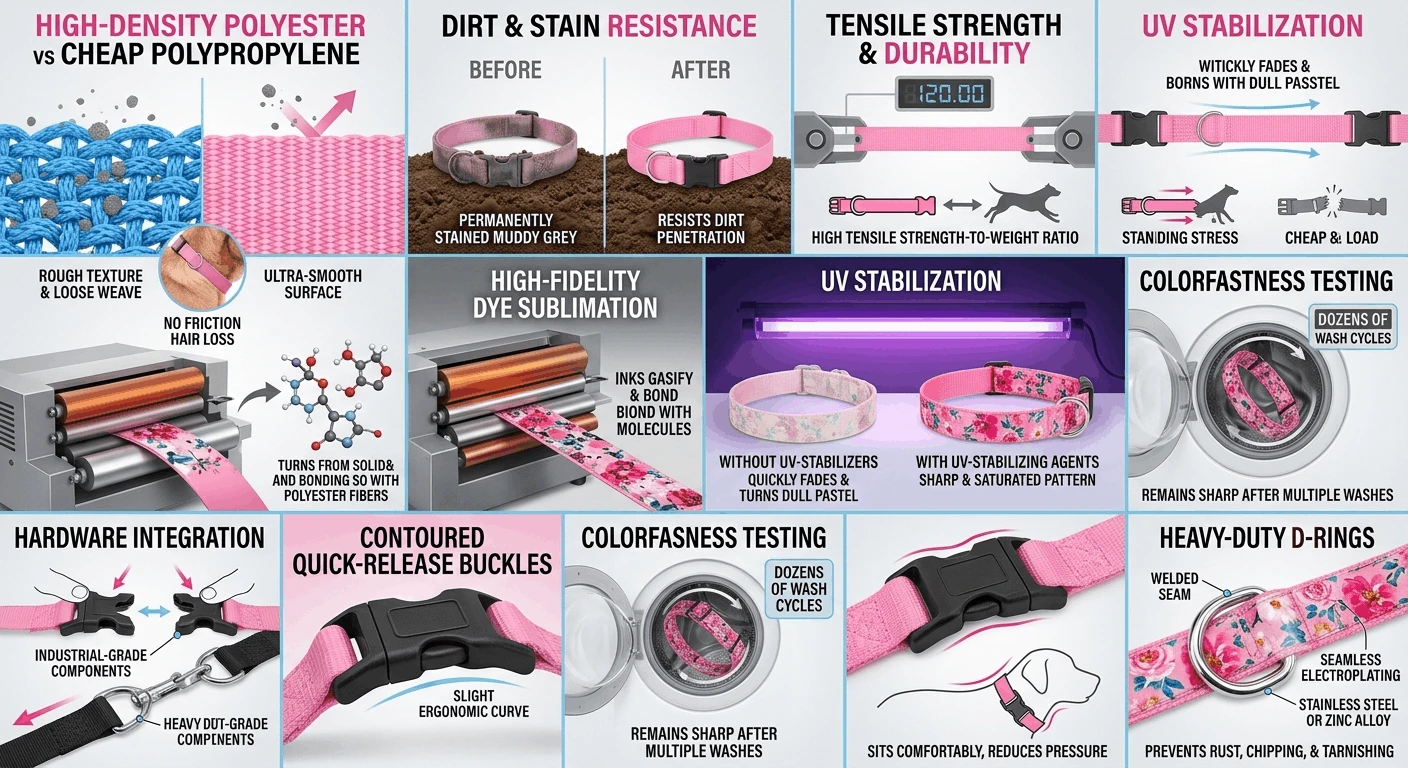
From a manufacturing and sourcing perspective, producing a successful light-colored product like a pink collar is significantly more difficult than producing a standard dark blue, forest green, or black collar. If a manufacturer uses cheap materials or flawed printing methods, a pink collar will look ruined after a single afternoon of digging in the dirt.
When sourcing premium pet accessories, buyers must pay attention to three critical engineering pillars:
High-Density Polyester vs. Cheap Polypropylene
The foundational webbing dictates the lifespan of the item. Cheap collars use coarse polypropylene fibers that have a rough texture and loose weave. Dirt particles get trapped between these loose fibers, permanently staining the pink fabric and turning it a muddy grey that cannot be washed out.
Premium manufacturing utilizes high-density, continuous-filament polyester webbing. This tight weaving pattern provides an ultra-smooth surface that resists dirt penetration, while offering a much higher tensile strength-to-weight ratio. The smooth surface also ensures that the collar does not cause friction hair loss around the dog's neck.
High-Fidelity Dye Sublimation and UV Stabilization
To achieve complex patterns-such as florals, geometric lines, or abstract art-on a pink base, manufacturers rely on dye sublimation printing. In this process, specialized inks are transformed into a gas under high heat and pressure, forcing them to bond directly with the core molecules of the polyester fibers.
If executed incorrectly or without UV-stabilizing agents, the pink base will quickly fade into a washed-out, dull pastel when exposed to the sun's ultraviolet rays. A premium printed collar must undergo rigorous colorfastness testing to ensure that the pattern remains sharp and saturated after dozens of wash cycles and prolonged exposure to natural elements.
Hardware Integration and Structural Integrity
A common flaw in fashion-forward collars is the use of cheap, decorative hardware that sacrifices safety for looks. A premium collar must pair its visual design with industrial-grade components:
Contoured Quick-Release Buckles: The buckle should feature a slight ergonomic curve to sit comfortably against the rounded contour of a dog's neck, reducing pressure points.
Heavy-Duty Zinc Alloy or Stainless Steel D-Rings: The leash attachment point must be securely welded and finished with seamless electroplating to prevent rusting, chipping, or tarnishing when exposed to moisture.
4. Pattern Architecture: What Designs Move the Market?
When stocking an inventory line or designing a custom collection, relying on a single solid shade of pink limits your market reach. The real volume moves through well-curated print patterns. Let's look at the design styles currently dominating consumer demand.
Type 1: Botanical and Floral Motifs Style: Intricate watercolor cherry blossoms, bold tropical hibiscus, or subtle pastel leaf patterns overlaying a soft pink base. Target Audience: Boutique shoppers, lifestyle influencers, and owners of toy or companion breeds.
Type 2: Geometric and Abstract Patterns Style: High-contrast white and dark-grey chevron lines, minimalist terrazzo flecks, or clean vector grids. Target Audience: Urban pet owners who prefer a modern, architectural, non-traditional aesthetic for their pets.
Type 3: High-Visibility Whimsical Graphics Style: Playful repeats of stars, small fruits, or seasonal themes that create a fun, high-energy vibe. Target Audience: Mass retail markets, gifting seasons, and puppy owners looking for celebratory first gear.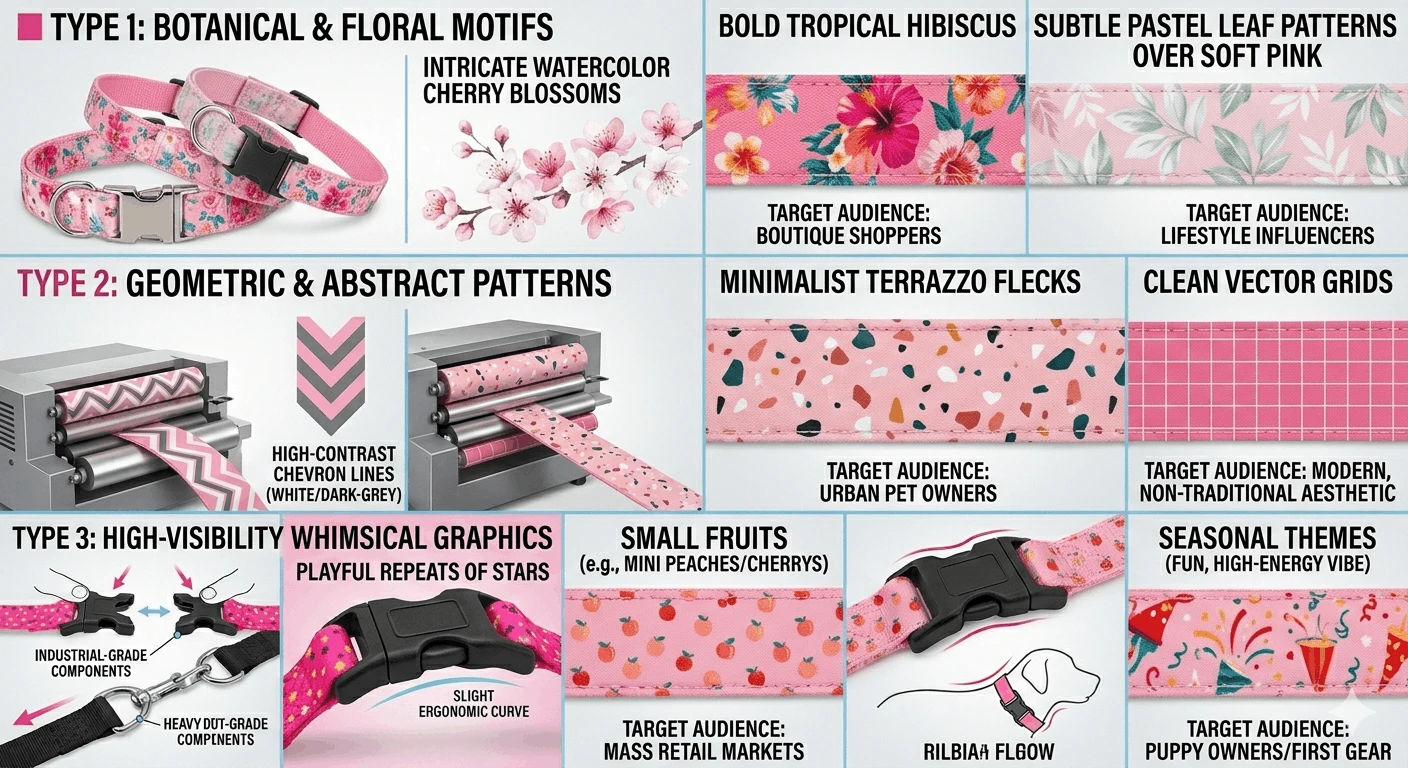
5. B2B Sourcing Guide: Evaluating Factory Partners for Custom Printing
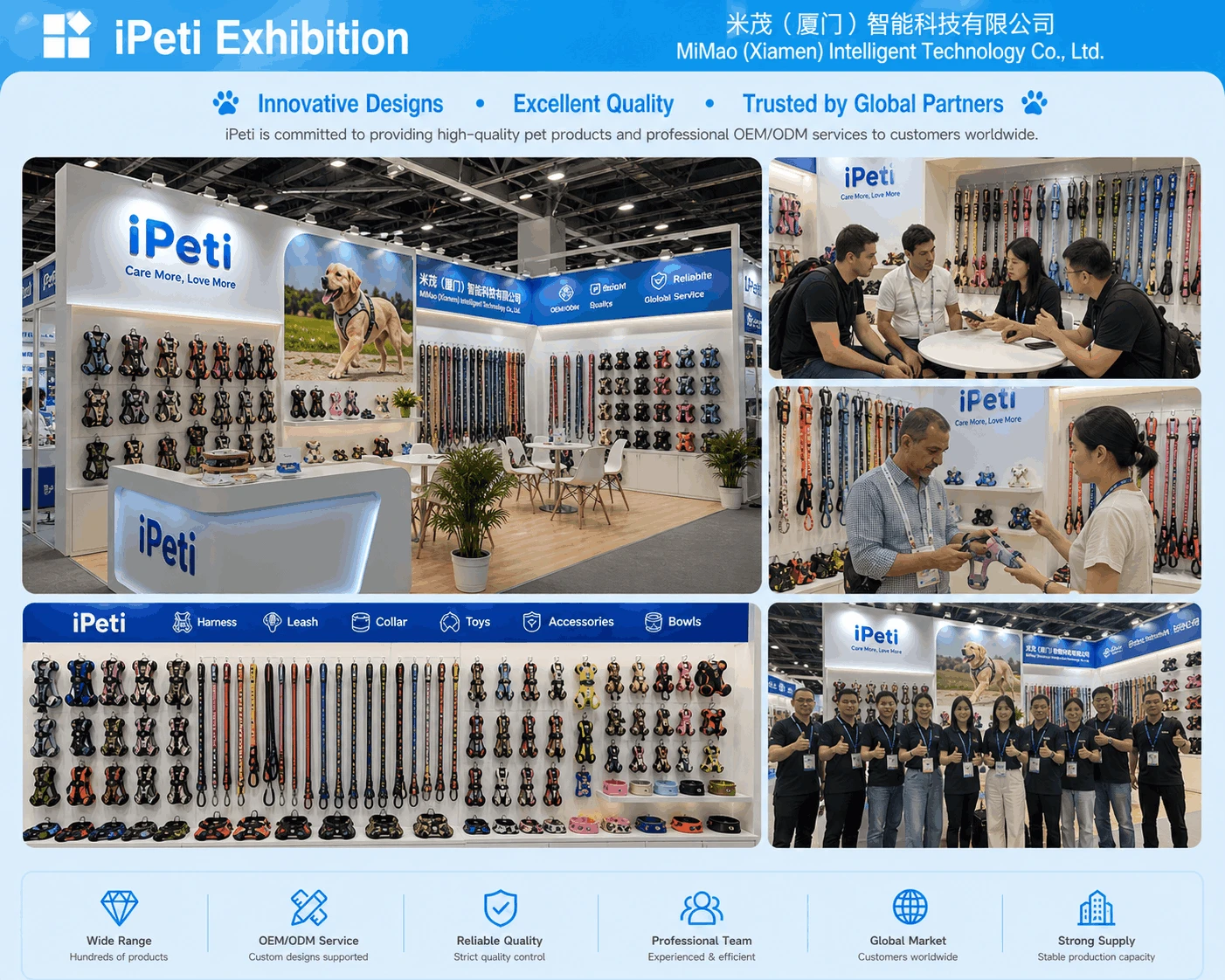
If you are an international pet brand coordinator, an independent boutique owner, or an e-commerce distributor looking to add a custom printed Pink Dog Collar line to your product catalog, selecting the right manufacturing partner is everything. A flawed factory choice leads to high return rates, customer complaints about staining, and split webbing under load.
Here is a practical checklist for evaluating a pet factory's printing and manufacturing capabilities:
1. Inquire About the Printing Technology
Always ask if the factory uses digital dye-sublimation or surface screen printing. Surface screen printing lays ink on top of the fabric like a sticker; this ink will crack, peel, and scratch off the moment a dog scratches its neck with its hind claws. Demand dye-sublimation, where the ink becomes one with the textile fibers.
2. Check the Finish and Stitching Standards
Look closely at the sample photos or physical prototypes. Are the raw edges of the webbing cleanly melted and folded under to prevent fraying? Does the factory use heavy-duty box stitching (the classic "X" inside a square pattern) around the buckle and D-ring attachments? Weak stitching is the number one cause of structural collar failure.
6. Sizing Architecture and Ergonomics for Growing Dogs
A common mistake made by consumers-and overlooked by brands-is failing to account for how a collar behaves across different growth stages, particularly for young puppies where pink gear is incredibly popular.
The Puppy Growth Phase
Puppies grow at an astonishing rate, sometimes doubling their neck circumference in a matter of weeks. If a brand offers a fashion collar with limited adjustability, the consumer feels cheated when the item is outgrown immediately. A well-designed collar line must feature a wide adjustment range, facilitated by a smooth, non-slip tri-glide slider that stays locked in place once set, preventing the collar from loosening under leash pressure.
Proportional Webbing Widths
A single webbing width does not fit all dogs. A 1-inch wide collar looks great on a Golden Retriever but will weigh down and restrict the neck movement of a Pomeranian puppy. Professional product structuring requires proportional scaling:
| Collar Size | Target Neck Circumference | Recommended Webbing Width | Ideal Hardware Type |
| Extra Small (XS) | 8" - 12" (20 - 30 cm) | 5/8 inch (1.5 cm) | Ultra-lightweight resin buckle |
| Small (S) | 10" - 14" (25 - 35 cm) | 5/8 or 3/4 inch | Lightweight contoured buckle |
| Medium (M) | 12" - 18" (30 - 45 cm) | 3/4 or 1 inch | Medium-duty reinforced resin |
| Large (L) | 16" - 24" (40 - 60 cm) | 1 inch (2.5 cm) | Heavy-duty dual-prong or metal-hybrid |
7. The Retail Economics: Why Patterned Collars Offer High Margins
- From a pure business perspective, investing in custom patterned inventory is one of the smartest moves a pet retailer can make. The pet industry is notoriously competitive, with basic commodities suffering from a race to the bottom in pricing.
- Plain black or red nylon collars have been commoditized to the point where consumers know exactly what they should cost. It is incredibly difficult to command a premium price for a basic item that looks identical to a dollar-store alternative.
- However, custom prints shift the consumer's brain from evaluating utility to evaluating art and identity. When a pet owner falls in love with a unique, beautifully executed floral or geometric print on a soft pink base, their price sensitivity drops dramatically. They are no longer buying a strap to hold a leash; they are buying an accessory that completes their dog's public persona.
- For e-commerce brands, this emotional connection translates directly into higher average order values (AOV), better margins, and a much higher likelihood of cross-selling matching leashes, poop bag holders, and harnesses to complete the "full walk set" aesthetic.
8. Consumer Maintenance: Keeping the Pink Vibrant
To minimize product returns and foster long-term customer satisfaction, brands should actively educate their audience on proper product maintenance. Because pink is a lighter tone, it will show everyday environmental dust faster than a black collar. Luckily, high-density polyester prints are incredibly resilient if handled correctly.
Here is a straightforward care guide that can be printed on packaging inserts or included in product listing details:
- Step 1: The Pre-Soak If the collar is caked in dried mud after a park trip, submerge it in a bowl of warm water mixed with half a teaspoon of laundry detergent or mild dish soap for 10 minutes to loosen up organic debris.
- Step 2: Gentle Surface Agitation Use an old soft-bristled toothbrush to gently scrub along the printed pattern. Avoid using harsh metal wire brushes or abrasive kitchen scouring pads, as these can snag the fine polyester fibers and create fuzzing.
- Step 3: Stain Remediation (Optional) For stubborn grass stains or oil marks, apply a small dab of oxygen-based stain remover directly to the spot. Avoid using chlorine bleach, as it will break down the molecular bonds of the polyester webbing and cause the pink dye to yellow or fade.
- Step 4: Air Drying Protocol Rinse the collar thoroughly under cold clean tap water. Squeeze out excess moisture with a dry towel and lay it flat to air dry away from direct, high-heat sources. Do not tumble dry in a commercial dryer, as extreme heat can warp the plastic internal components of the buckle.
9. Future Trends: The Convergence of Fashion and Function
- As we look toward the future of the pet accessory market, the demand for styled aesthetics shows zero signs of slowing down. The brands that will win the next decade are those that successfully merge high-end visual design with uncompromising technical performance.
- We are already seeing early market interest in matching sustainable textiles-such as rPET webbing made from recycled ocean plastics-with premium dye-sublimation printing. Consumers want to feel good about the environmental footprint of their purchases while enjoying the vibrant, fashionable choices that define modern pet parenthood.
- Whether you are a retail store owner looking to refresh your seasonal display, a global brand developing a signature custom collection, or an online marketer optimizing an e-commerce platform, recognizing the structural and emotional power of the printed Pink Dog Collar ensures your inventory stays aligned with where global consumer spend is actually moving. It is a perfect blend of consumer psychology, textile engineering, and lifestyle marketing that transforms an everyday dog walk into a curated fashion statement.